Learning
Project managers make decisions every day—about priorities, resources, risks, opportunities, investments, stakeholders, and how to respond when circumstances change. Yet many of these decisions are difficult to understand through theory alone. The Project Win Game™ uses serious gaming to turn project management concepts into decisions that players can experience.
Players make choices, respond to changing circumstances, manage competing objectives, and experience the consequences of their decisions. This creates an environment in which complex project management concepts can be explored through action, reflection, and discussion.
Learning Through Decisions
The Project Win Game™ was originally developed to help players experience the differences in decision-making between traditional/Waterfall and Agile projects. The game now extends this experiential approach to two additional areas of project decision-making: Real Options and Moral AI. Together, the three learning areas explore an increasingly broad question:
How do project managers make good decisions when objectives compete, information is incomplete, and the consequences of today’s choices may only become apparent later?
Three Ways to Explore Project Decision-Making

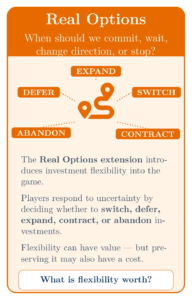

Each learning area approaches decision-making from a different perspective. Agile or Waterfall explores how the project approach changes the decisions managers make. Real Options introduces flexibility and investment decisions under uncertainty, including choices to switch, defer, expand, contract, or abandon. Moral AI expands the decision space beyond traditional project measures to include bias, explainability, governance, stakeholder impact, and unintended harm.
Learning Through Gamification
The important part of the game is not simply whether a player makes the “right” decision. It is experiencing the relationship between a decision and its consequences. Through the gamification of project management, abstract concepts become choices with visible outcomes. Players can experiment with alternatives, experience trade-offs, and discuss why different decisions produced different results.
Single-player and competitive play can be used to engage project managers and non-managers alike. For non-managers in particular, the game provides an opportunity to experience project management responsibilities rather than only hearing or reading about them.
The result is a learning environment built around a simple idea: Make the decision. Experience what happens. Reflect on why.